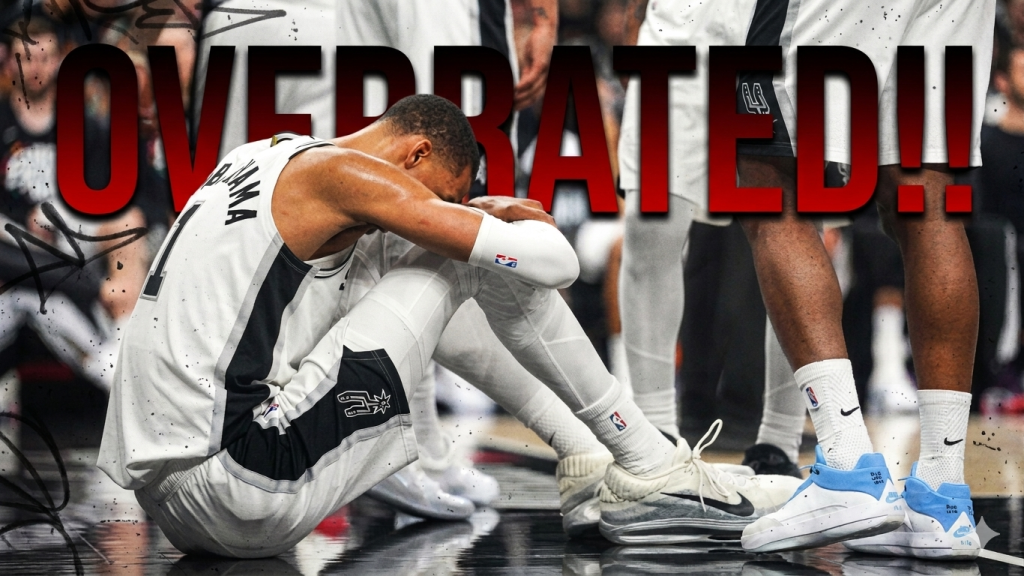
Stop. Before you smash your phone, hear me out. Or don’t. Because that’s the problem. We’ve reached a point in NBA discourse where any critique of Victor Wembanyama is treated not as an opinion, but as a blasphemy punishable by mockery.
The narrative is set in stone: Wemby is the unicorn. The savior. The alien. We are told he will win multiple MVPs, Defensive Player of the Year awards, and championships. He is the consensus “next face of the league” despite having played roughly 70 games.
But if we strip away the awe of his dimensions—7-foot-4 with a 9-foot-7 standing reach—and look honestly at the product on the floor, a difficult truth emerges: Victor Wembanyama is the most overrated player in NBA history. And the silence from analysts is deafening.
The internet loves the clips. Wemby taking a cross-court dribble from the three-point line. Wemby blocking a jump shot without jumping. Wemby hitting a step-back triple over a 6-foot-8 defender. What the highlights don’t show is the inefficiency. For all the “he’s 7-foot-4 and plays like a guard” praise, ask yourself: Should a 7-foot-4 player take 6.5 three-pointers a game at a 32% clip? If any other center—say, Rudy Gobert—attempted that volume at that percentage, we would call it a coaching malpractice. For Wemby, it’s “expanding his game.” He shoots below 47% from the field. For a man who can literally place the ball into the rim without jumping, that is not just mediocre—it’s alarming. He settles for fadeaways over smaller defenders. He turns the ball over 3.5 times per game. He plays with the shot selection of a volume shooting guard trapped in a center’s body. It’s exciting. It’s not winning basketball.
The standard rebuttal is: “Look at his blocks! Look at his points! He’s putting up video game numbers on a bad team!” Exactly. On a bad team. The graveyard of NBA history is littered with stat-sheet stuffers who compiled empty calories on lottery squads. Michael Adams averaged 26 points and 10 assists in 1991 on 39% shooting. Where is his statue? Kevin Love grabbed 15 rebounds a game in Minnesota while missing the playoffs. Those numbers became complementary once he joined a contender. Wembanyama is the king of “irrelevant impact.” He blocks shots, sure—but teams have already figured out that pulling him to the perimeter opens the offensive glass. His defensive positioning is often chaotic, relying on his absurd length to recover from mistakes. That works in November against Portland. It will not work in May against Denver.
Here is the real reason he is overrated: No one is allowed to criticize him without being labeled a hater or a dinosaur. When Zion Williamson showed up overweight, the criticism was immediate. When Ja Morant flashed guns, the condemnations were swift. When Chet Holmgren gets backed down in the post, analysts note his “frame limitations.” But Wembanyama? Any criticism is met with a wall of digital fury. “You just don’t understand his uniqueness.” “You’ve never seen anyone like him.” Correct. I haven’t. Neither has history. That doesn’t automatically make him great. It makes him a science experiment. We are so enamored with the idea of Wembanyama—the 2020s basketball lab creation—that we’ve stopped asking if the results are actually good.
Let’s say the worst thing an NBA analyst can say: He will not play 65 games a season for more than two years of his career. Look at his frame. Look at the torque he puts on those stilts. Look at the history of every 7-foot-3+ player in NBA history. Yao Ming broke down. Ralph Sampson broke down. Kristaps Porzingis is a cautionary tale, not a blueprint. Wembanyama plays harder and faster than any of them. That is not a recipe for longevity—it’s a countdown to a stress fracture. Yet we are already engraving his Hall of Fame plaque.
Victor Wembanyama is a marvel of nature. He is must-see TV. He is also, by the gap between his current reputation and his current production, the most overrated player we have ever seen. The emperor has no jumper. And one day, we’ll have to admit it.